Diversity and equitable practices in our communities and schools will benefit all.
  Lisa Goolcharan
  • Home
  • Edu Development
  • Philosophy
  • Resumé
  • References
Evidence & Description Multidisciplinary Unit. Grade 4-6. Theme: Diversity (Science: biodiversity, plants and animals; ELA: Author Study Comparing works for diversity; Mathematics: Statistical and Probability Analysis)

Rationale  I use various ELA practices and elements. The evidence shows how students benefit in a contextual, interdisciplinary learning environment and are empowered though inquiry-based, research investigations to promote critical thinking. They also co-constructed meaning with their families in a debate.

Multi-Disciplinary Unit

Creating cross-curricular lessons are beneficial because they are clearer representations of the world, and they allow students to make deeper, more relevant connections between ideas. These connections are made more easily because the learning is contextualized in an authentic, multi-disciplinary process. Below is a multi-disciplinary unit design for grades 4 to 6.

A) Science: Biodiversity
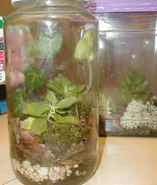
  1. Students used the scientific method when experimenting with terrariums. They built one small terrarium, and as a class, we created a larger one. Visual dictionaries were created of the terrarium to demonstrate observation and diagram skills.

  2. To reinforce the scientific method, observation, and life skills, students performed an experiment using triops. This gave students the opportunity to study plants and animals.

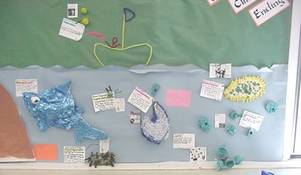
  3. Students represented kingdoms with an art project utilizing recycled materials to make creatures from each kingdom with texture. They used this in a celebration of Earth Day.

  4. Students, in groups, researched one creature from each kingdom to make an art project. The students collected data about classification, adaptations, physical description, reproduction, habitat, and listed endangered species.

  5. Students performed drama presentations of the kingdoms to evaluate their overall learning while reinforcing concepts for the class. There were many interesting presentations including game shows, talk shows, and dramatized school science labs.
Vertical Divider
Picture
Plants & Animals 
Students created terrariums in groups and constructed a larger one as a class. There was a focus on using the scientific method and observation skills as a way to understand and answer hypotheses. These experiments were followed by breeding triops. The students were engaged and eager to put their investigative skills to use.
Picture
3-D Representations of Creatures
Constructed by groups with recyclables materials to creatively demonstrate their learning.
B) ELA: Author Study, Diversity of Writing
  1. Students joined groups based on their chosen books and participated in literature circles. Each circle chose a different book from an award winning author for their author study.
  2. Students were selected different roles during the literature circles including discussion director, connector, passage picker, and vocabulary wizard. Each student was a summarizer for each circle, as well. Students were assessed on skills through self, peer and teacher evaluations.
  3. Students had the opportunity to compare each of the books by writing speeches about the lack or the abundance of diversity in this author's writing. They learned how to compare and contrast literature and identify key story elements.
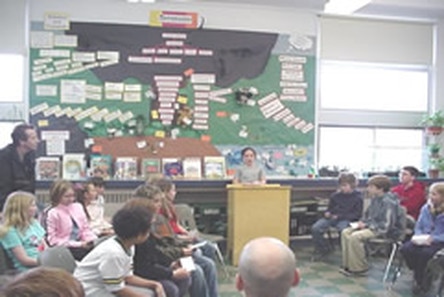
  4. Students learned effective presentation skills after joining new groups based on being for or against the diversity of an author's work. Numerous parents and community members watched the debate using a rubric to assess the students abilities to present in an effective and appropriate  manners while providing comments about content.
Picture
Author Study
Students performed a debate on an author's novels in an authentic context. There goal was to persuade parents and community members to agree or disagree with the statement: The author is a diverse writer.
 
   
 C) Mathematics: Statistics and Probability about School Environment
  1. Students learned to develop probability experiments and statistics to gather and analyze data by making meaningful surveys and visual representation.

  2. The main task called " Diversity of thought" including a statistical analysis of aspects of the school environment. Students made authentic surveys about the groups chosen topics. Topics included the ecological environment, bullying, medical care, and student life etc. After data was collect, students created relevant graphs and charts representing the various data. Students then interpreted and presented their findings to the class.
Picture
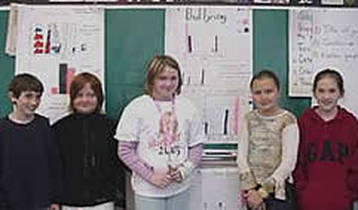
Statistical Study: Bullying
Students learned statistical studies and analysis. They developed and completed a study from which they made visual organizers of the results. This group's topic was bullying. They defined the population of the study as well as the sample. They chose this topic because they were curious about the frequency of bullying at the school and how students typically handled bullying. They made three visual organizers including: frequency of bullying, reactions to bullying, and reactions to witnessing bullying. A local organization for teens, upon hearing about the study, requested the collected data for their own program, showing the relevance and success of the students' work.

Powered by Create your own unique website with customizable templates.